
Before his photography exhibition opened earlier this month, Ocean Vuong and I briefly discussed Connecticut’s incongruity: the mansions of leafy Greenwich versus rundown Hartford’s sinking triplexes on sunbaked streets; cheery, oblivious suburban bliss amid a loud, bloody war machine fed by Colt, Sikorsky, Pratt & Whitney, and similar entities based in the Nutmeg State.
This polarity is at the core of the show, I’m Sorry I Love You, a collection of images of family and friends Vuong took in and around Hartford, where he grew up.
We see the tension in the title itself – the lack of comma skews the meaning; is this contrition to the beloved or because of the love? – and in the show’s presentation, too: unframed images pinned to a wall, the room bisected by a clothesline dangling a square of silk bearing the image of a Hartford bodega’s Puerto Rican flag mural.
The effect is an unfinished nonchalance that speaks to this type of show’s ephemerality while rebelling visually against traditional presentation in the iconic Wadsworth’s hallowed halls.
A related theme – remaining authentic while engaging institutions – was one of the first topics that came up when Vuong later sat with Dr. Quan Tran from Yale University in the museum’s Avery Memorial Theater.
Vuong notes that, yes, writers and other creatives can aspire to be seen in or at legacy outlets like The Wadsworth or The New Yorker, because those places do grant a form of legitimacy.
But – and this is a big but – he says the key is to not let acceptance in those spaces define you. That legitimacy does not make you better than the next artist or writer or whoever. Acceptance in those spaces is not ultimate validation. When you lose sight of that, creativity is lost.

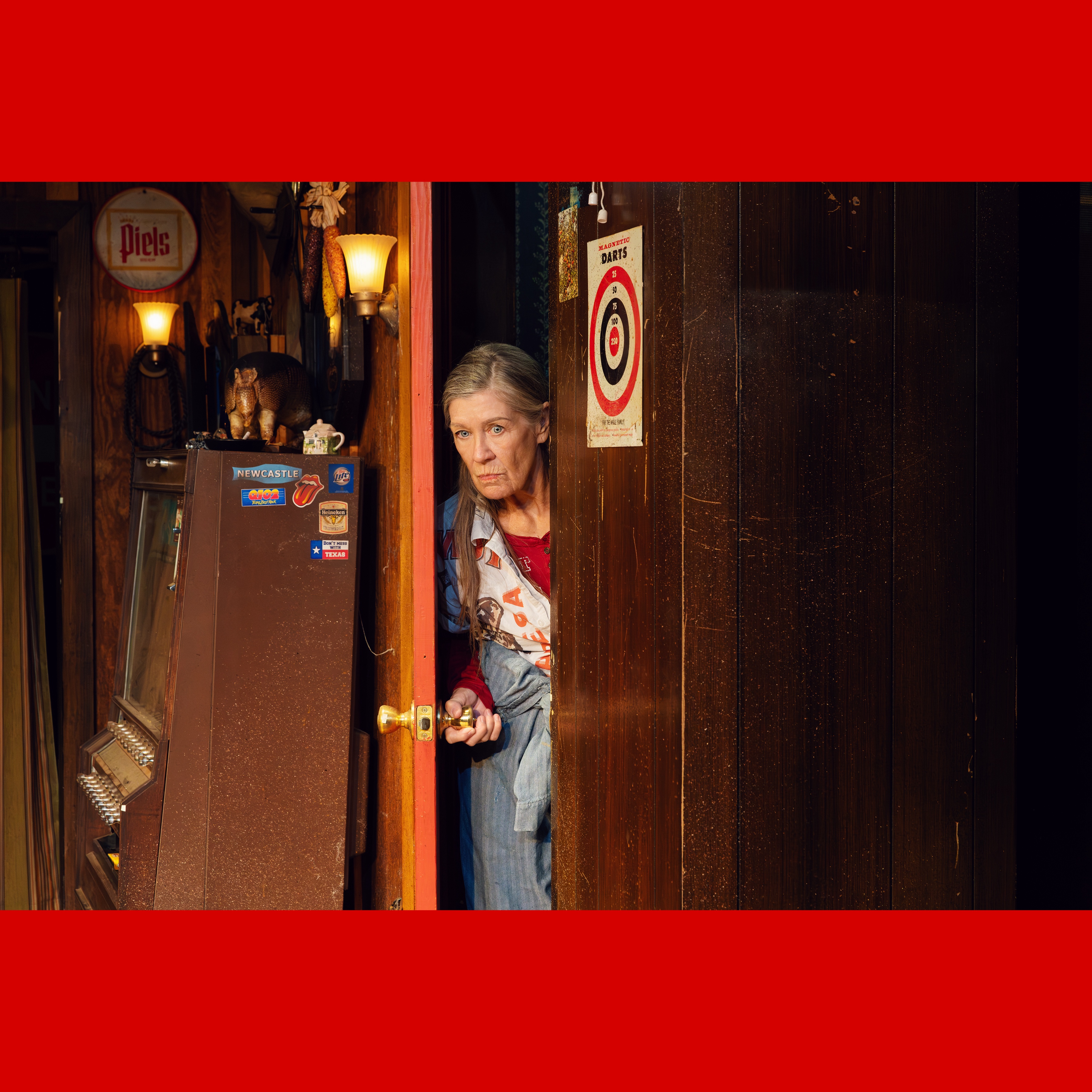
This image depicts Vuong’s mother and friend in a style reminiscent of 19th century portraiture, defying social assumptions.
Vuong also discussed the difference between writing, a form for which he’s most famous, and photography. For all the possibilities writing offers, it remains linear; on a track. Nouns. Verbs. You have to work hard to create parallels. It “makes demands” of the creator – you must conjure this world – and can be done anywhere – he could describe Earth while on Mars.
Photography has a “thereness.” It “punches through space and time,” drawing power from the limitation of a moment, like a haiku. Photography allows a simultaneity impossible in writing. As Vuong said, “There’s no ‘meanwhile’ in photography.”
The images collected here are more than Vuong documenting his loved ones in specific moments. They work against visual tropes of Vietnamese people. As Vuong explained, most images of Vietnamese bodies in America are from the war or its aftermath: they’re murdered, brutalized, naked and covered in napalm. There’s no agency, no individuality.

Vuong’s friends and family are people who have their own desires, lives, and identities. Notably, there’s only one smile – a choice Vuong made to counter broader depictions of Asians in America: the “high-earning Asian,” the subservient Asian, the Asian smiling and welcoming and eager to please. He affords them a “dignified presence” so often denied Asians in America generally, and it’s gorgeous.
Reading about this show and seeing it are of course entirely different experiences, so I urge you to visit The Wadsworth to take in Ocean Vuong’s view. You won’t be sorry.
Vuong’s show, I’m Sorry I Love You, runs at The Wadsworth’s MATRIX gallery through January 24, 2027. And in case you missed it, here is Ocean Vuong speaking with Dr. Quan Tran at The Wadsworth:



Leave a Reply